Showing posts with label Africa. Show all posts

Thursday, October 5, 2017

Letter from Africa: Can Nigeria avoid repeating past mistakes?

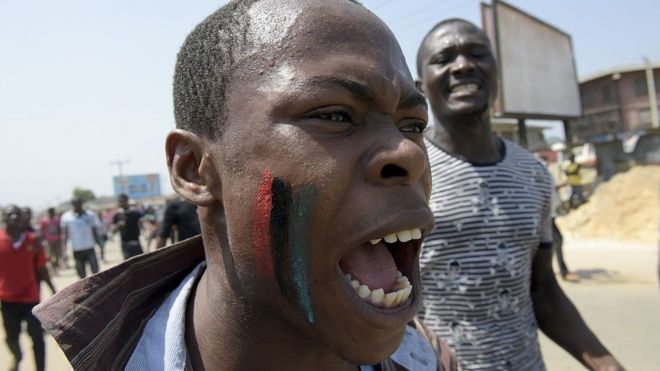
A pro-Biafra supporter chants a song in Aba, southeastern Nigeria, during a protest calling for the release of a key activist on November 18, 2015.
A secessionist group is campaigning for independence in south-eastern Nigeria


In our series of letters from African journalists, novelist and writer Adaobi Tricia Nwaubani writes that many of the hopes Nigerians had at independence have been dashed.
Of all the stories I have heard of the day when Nigeria gained independence from Britain on 1 October 1960, the most memorable is the one told by my friend's father, Onye Kamanu, who had spent the preceding night at Tafawa Balewa Square in the then capital, Lagos.
Sitting on the surrounding walls and bare ground were thousands of Nigerians, who, like him, could hardly wait to usher in the day that their country would finally be free from colonial rule.

'Joy and pride'

With tears in his eyes, Mr Kamanu recalled the occasion, describing the deafening bellow of triumph that went up from the teeming crowd when the British Union Jack finally went down and the green-white-green Nigerian flag was hoisted.
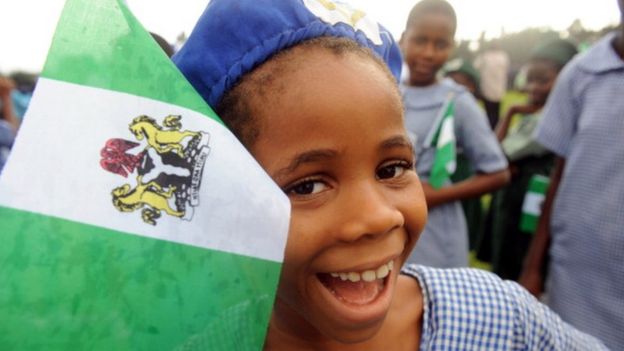
A Nigerian student smiles as she attends independence day celebrations in Lagos ion 1 October 2013
Nigeria's then Prime Minister Tafawa Balewa captured the mood of the entire nation during his Independence Day speech.
"This is a wonderful day and it is all the more wonderful because we have awaited it with increasing impatience. Words cannot adequately express my joy and pride at being the Nigerian citizen privileged to accept from Her Royal Highness these constitutional instruments which are the symbols of Nigeria's independence," he said.
"It is a unique privilege which I shall remember forever, and it gives me strength and courage as I dedicate my life to the service of our country," he added.
Shortly after witnessing the historic event, Mr Kamanu received a scholarship to study at an American university. Throughout the journey by sea, he was fed little else but macaroni and cheese, hence his subsequent lifelong abhorrence of the meal.

'Full splendour'

Once in the US, he boasted to his classmates about the future of Nigeria, Africa's most populous state.
"Nigeria is going to be a world power in the next few years," he said. "Oh, you just wait and see."
Mr Kamanu was certain that, with the coloniser gone and with the advent of self-rule, Nigeria would soon bound forth like a racehorse released from its stall.
That same year, a total of 17 African states celebrated their independence from the UK, France and Belgium.
I understand that a cartoon at the time depicted the map of Africa as a growing giant bursting out of its chains.
Nigeria: Key facts
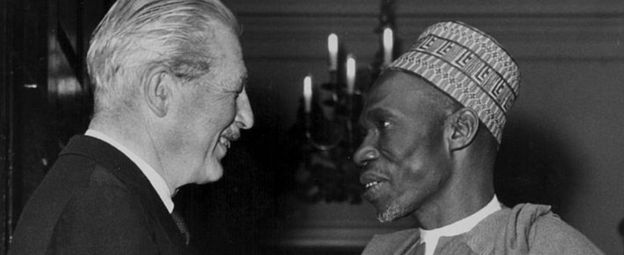
Nigerian politician Abubakar Tafawa Balewa meeting British Prim Minister Harold Macmillan at Admiralty House, London, September 6th 1962Image copyrightGETTY IMAGES
  • 1960: Independence from Britain
  • 1966: Prime Minister Tafawa Balewa (above, right) killed in a coup
  • 1967: Civil war breaks out over secessionist attempt in south-east
  • 1999: Military government hands over power after elections
  • 2009: Militant Islamist group Boko Haram launches insurgency in north-east
  • 2015: Muhammadu Buhari wins presidential election; first opposition candidate to do so

Clearly, Mr Kamanu was not the only one with high hopes. Others also expected that a continent, blessed with natural resources and hard-working people, would arise in her full splendour and shine.
About 40 years after independence, Mr Kamanu travelled from Nigeria to attend his college reunion in the US. His classmates remembered how loudly he had boasted.
"I thought you said Nigeria was going to be a world power?" they asked, giggling and nudging one another. "So, Onye, what happened?"
A lot happened.
Within six years of his emotional speech, Mr Balewa was assassinated in a coup.
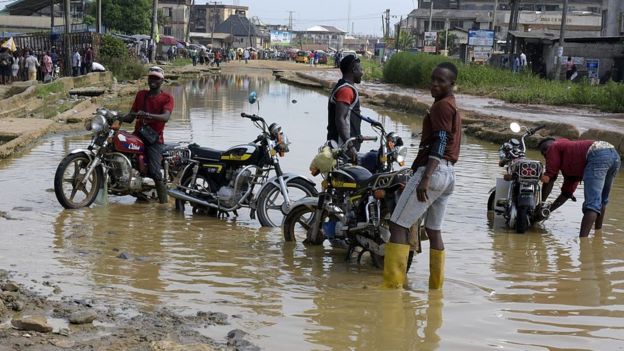
Motorcyclists wash their bikes in the flooded and dilapidated Port Harcourt-Aba highway abandoned by maintenance agencies resulting in an ongoing pro-Biafra protesters agitating for the breakaway of a Biafran state, on November 18, 2015About a year later, Nigeria plunged into a civil war after member of the Igbo ethnic group tried to secede and form the breakaway state of Biafra in the south-east.
Three years of war eventually ended and three decades of coups and dictatorships followed.
Human rights abuses and pillaging of the nation's vast resources by those in power carried on with little restraint.
Nigeria finally found her way back on to her feet with the return to democracy in 1999.
The giant of Africa leaped several steps forward in March 2015 when the government of Goodluck Jonathan was voted out, the will of the people prevailing, for the first time, over the power of an incumbent.
That historic election of President Muhammadu Buhari led many Nigerians to be as optimistic as Mr Kamanu was in 1960 about the country's future.
But barely two years later, some of the forces that derailed Nigeria then are once again flashing their sharp talons.Particularly alarming are the ethnic agitations sounding from almost all parts of the country, especially from the south-east where clashes between the military and the separatist group, the Independent Peoples of Biafra (Ipob), have led to the loss of life and property.
In the media and in daily conversation, Nigerians continue to express their fears about how much more ferocious the crisis could become if not handled with immense care.
This is one déjà vu that Nigeria cannot afford. The giant of Africa has marched too far to be suddenly crippled by the same old mistakes.
As my country celebrates her 57th year of independence, my prayer is that the Nigerian government will handle these agitations with compassion and great wisdom.
Surely none of us wants to look back at this era of hope and struggle to answer the question: "What happened?"
Tuesday, October 3, 2017

Vigilantes kill six suspected ‘vampires’ in Malawi

Vigilantes in Malawi have killed six people suspected of trying to obtain and drink human blood as part of magic rituals since mid-September, police told AFP on Tuesday. Malawi, where witchcraft is widely believed and education standards are low, is regularly dogged by rumours of “vampire” activity.

The six people were killed in three separate incidents in the area surrounding Mulanje Mountain in the country’s south. The most recent attack came on Sunday when an angry mob beat two people to death because they “suspected the two (victims) of being blood suckers”, said police spokesman James Kadadzera. The victims were travelling to pray close to the mountain when they were intercepted by a violent crowd on their way through a village. In another incident, Kadadzera said a local chief was killed by a group accusing him of colluding with men suspected of consuming human blood. “There is no evidence about the blood suckers… we blame communities for taking the law into their hands,” he said, adding that local people targeted the victims because they were believed to be seeking blood for spiritual rituals. “There is no evidence of blood sucking and nobody has come to police to complain.” Police have deployed more than 100 riot officers to the region in response to the killings. The United States embassy in Malawi has temporarily withdrawn its team of Peace Corps volunteers from the four districts bordering Mulanje and advised its citizens not to visit the area. In a statement, the embassy blamed “ongoing acts of vigilante justice stemming from rumours of persons attempting to siphon blood from local residents for ritualistic use.” In the 1970s, the government of former dictator Hastings Kamuzu Banda was accused of killing a dozen residents in a suburb of southern city Blantyre in order to send their blood to apartheid-era South Africa. Although the culprit was eventually caught and jailed for life, the murders still haunt Malawi. The issue of vampires remains a sensitive one for officials in Malawi. In 2003, police arrested a radio journalist for interviewing a man who claimed his village was visited by blood-sucking vampires. He was later released. The government has previously been forced to deny that it collaborates with international aid organisations to take blood from impoverished villagers in exchange for food supplies.

Read more at: https://www.vanguardngr.com/2017/10/vigilantes-kill-six-suspected-vampires-malawi/

Tuesday, September 26, 2017

Seven arrested in Egypt after raising rainbow flag at concert

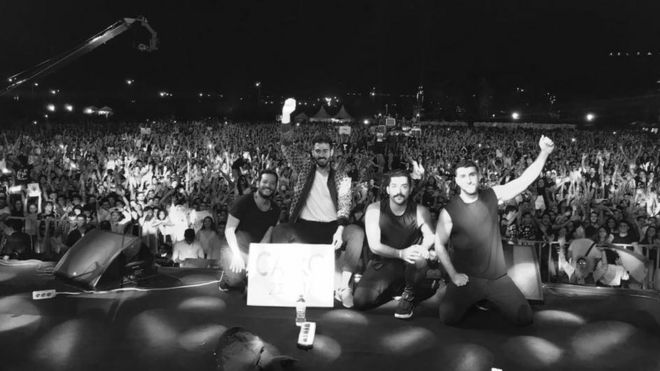
Mashrou' Leila at concert in Cairo on 22 September 2017Image copyrightMASHROU' LEILA
Image captionMashrou' Leila said the Cairo concert had been one of the best they had played
Egyptian police have arrested seven people after they were allegedly seen raising rainbow flags at a concert in Cairo last week, security sources say.
The seven were reportedly detained on Monday for "promoting sexual deviancy", but have not yet been formally charged.
Prosecutors opened an investigation after images from the concert by the Lebanese band Mashrou' Leila - whose lead singer is openly gay - went viral.
Homosexuality is not explicitly criminalised under Egyptian law.
But the authorities routinely arrest people suspected of engaging in consensual homosexual conduct on charges of "debauchery", "immorality" or "blasphemy".
The advocacy group, Solidarity With Egypt LGBTQ+, said late last year that it had recorded 114 criminal investigations involving 274 lesbian, gay, bisexual and transgender individuals since 2013.
The raising of the rainbow flag was a rare public show of support for the LGBT community in the conservative Muslim country.
Late on Monday, the state news agency reported that Public Prosecutor Nabil Sadek had ordered an investigation by the State Security Prosecution after images posted on social media were condemned by several politicians and media figures.
The deputy head of the Egyptian Musicians Syndicate, Reda Ragab, meanwhile said it would be taking steps to stop Mashrou' Leila performing again in the country.
"We are a religious, conservative society, an identity we need to preserve," he told the Daily News Egypt website.
"This is a scandal against our traditions and far from serious and meaningful art."
The Egyptian feminist and writer Mona Eltahawy condemned the actions of both the authorities and the musicians syndicate.
"It is utterly ridiculous to arrest anyone for waving a flag. It is utterly ridiculous to arrest anyone for their sexuality as #Egypt does," she wrote on Twitter.
Mashrou' Leila has twice been banned from performing in Jordan. On Saturday, it said the Cairo concert "was one of the best shows we've ever played".
"Was an honour to play to such a wonderful crowd! So much love!"

Saturday, September 23, 2017

Herdsmen vs IPOB: Presidency reveals why pro-Biafra group is more dangerous than Fulani Herdsmen(Nigeria)

-        Senior special assistant on media and publicity Garba Shehu says IPOB had all the appearances of a terrorist organisation 

- Unlike IPOB, Fulani herdsmen, he said, were only a criminal organisation

 - Garba Shehu named at least five reasons that made federal government consider IPOB more dangerous than herdsmen 

        The Nigerian Presidency has listed reasons why it brought down the hammer on Indigenous People of Biafra (IPOB) while appearing to ignore the activities of rampaging Fulani herdsmen. According to the presidency, IPOB had clear tendencies of a terrorist group while the herdsmen were just a criminal group. 
     
         The clarifications were made by President Muhammadu Buhari’s media aide Garba Shehu in an interview with Nigerian Tribune published on Saturday, September 23. According to Shehu, comparing IPOB to the herdsmen is like ‘comparing apples with paw paws’. 

Explaining further, Shehu gave five reasons why the federal government deemed IPOB more dangerous than Fulani herdsmen.

 1. State declaration IPOB declared the state of Biafra. He said: “The herdsmen, no matter how criminal their actions, have never declared a sovereign state within Nigeria.”

 2. Holding Nigerian territories According to Shehu, IPOB was holding on to Nigerian territories and making moves to take more. “They don’t have territorial ambitions. IPOB on the other has put us on notice that they want to take Kogi, Benue, Rivers, Bayelsa and Delta!”

 3. Flags Shehu also noted that the pro-Biafra secessionists had flags like terrorist groups 4. Passports The presidential aide also made allusion to the creation of embassies across the world by IPOB. He said:

 “The Fulani don’t have flags or national passports” The presidency also said the government was able to quickly identify the source of IPOB’s funding but had failed to trace that of Boko Haram because the method used by the pro-Biafra group to source for funds was open. 

Friday, September 22, 2017

70-YR-OLD MAN WITH 3 WIVES, 14 CHILDREN ARRESTED FOR RAPING 7-YR-OLD ORPHAN FOR 4 YEARS


.
The police have arrested a 70-year-old man in Akpoha, Ebonyi state, Simon Alobu, for allegedly hypnotizing and repeatedly raping a 7-year-old orphan, Favour. Favour was first raped in 2014 and since then, the man has allegedly been raping her. 
.The suspect tore Favour’s bottom with razor blade where he presumably apply some charms to prevent the girl from revealing his identity until the girl revealed his illicit acts on her after attending a crusade at Adoration Ministry, Enugu owned by a Charismatic Catholic Priest Rev. Fr. Ejike Mbaka. 
.Favour is facing health challenges with a body odour following the rape. She is yet to be given adequate medical treatment. Alobu was handed over to the police by a special court in the state known as family law centre where the matter was reported by Favour’s aunt, Enya Martha. 
.The man married three wives and has 14 children. None of the wives and children are living with him. One of his wives was divorced while another is dead. The remaining one left him and went to her son who is living outside the area. 
The suspect lives in the same compound with the girl and her aunt and was reported to the centre by the victim’s aunt Enya Martha who alleged that the man also raped her when she was a little girl. 
Narrating her ordeal in the hands of Alobu, the victim said “the man said I should come and prepare food for him. After preparing the food, my brother who was with me said he was not eating and left immediately.
When my brother left and I was still eating, the man locked the door and carried me to his bed and raped me”. The girl’s aunt, became aware of Favours condition after she complained of severe pains in her private. 
According to the woman, she took the girl to Afikpo where the rape was confirmed why efforts to make her reveal the identity of the rapist failed as he continued the act till this year. 

Migrant crisis: Dozens feared drowned off Libya coast

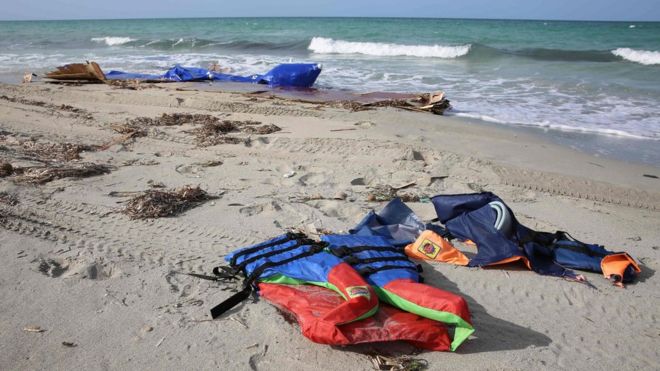
Life jackets washed up on a beach after dozens of migrants drowned in a shipwreck off the Libyan coast of on September 21, 2017
Lifejackets believed to be from the capsized boat were washed up on the coast

At least 50 migrants are feared drowned after their boat ran out of fuel and capsized off the Libyan coast.
The dinghy, which had been carrying at least 100 people, had set off from Libya's western city of Sabratha last Friday, local officials told the BBC.
The vessel was adrift for days before it capsized and was washed onshore near the city of Zuwara in the early hours of Wednesday.
Thirty-five survivors were found, along with eight bodies, officials said.
A spokesman for the Libyan navy said the survivors were all from sub-Saharan Africa.
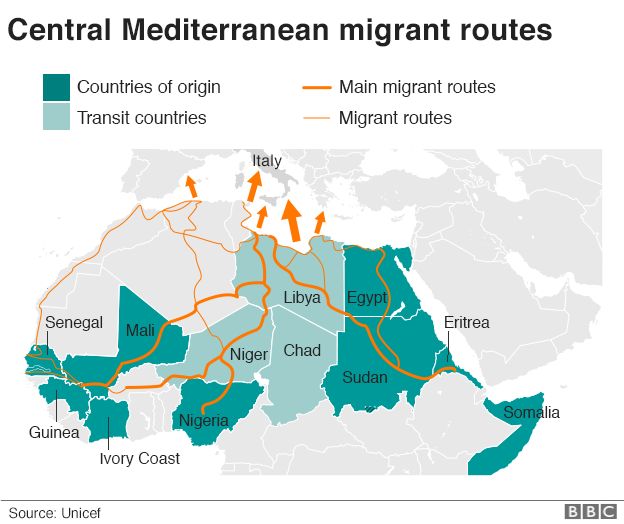
Libya is a popular transit route for migrants trying to reach southern Europe by sea. Many are packed into unseaworthy vessels by traffickers who then abandon them to their fate in the Mediterranean Sea.
Map showing Central Mediterranean migrant routes
More than 100,000 have crossed the Mediterranean to Italy so far this year, according to the UN. More than 2,400 people have died in the attempt.
  • Surviving the deadliest migration route
  • France plans asylum 'hotspots' in Libya
  • Jailed and ransomed in Libya
Migrants caught by Libyan authorities are often taken to overcrowded detention centres in Tripoli where they are kept in poor conditions.
Arrivals to Italy from Libya fell sharply earlier this summer following a reported deal between the internationally recognised government in Tripoli and a Libyan militia alleged to have been involved in human trafficking.
Italy's parliament also approved a plan to send naval boats to Libya to stop migrants crossing the Mediterranean.
A note on terminology: The term migrant to refer to all people on the move who have yet to complete the legal process of claiming asylum. This group includes people fleeing war-torn countries such as Syria, who are likely to be granted refugee status, as well as people who are seeking jobs and better lives, who governments are likely to rule are economic migrants.

Wednesday, August 9, 2017

Why 'A Nasty Boy' magazine is causing a stir in Nigeria


Bold, disruptive and totally unapologetic, a new Nigerian online magazine 'A Nasty Boy,' is set to ruffle a few feathers.
"Sometimes our visual content will not be safe for the workplace... we won't make it any easier for you with our provocative editorials and swear words; take it in good spirits," read's the magazine's disclaimer.
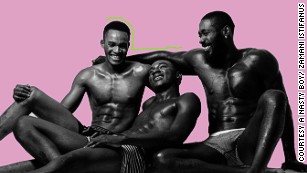
    The magazine is filled with provocative images, featuring nude models, articles contain swear words and avant-garde ideas.
    In Nigeria, a conservative country, where public expressions of nudity are uncommon, 'A Nasty Boy' is unsurprisingly causing controversy.
    But for editor Richard Akuson, the publication is sending out a clear message: he's not interested in fitting the status quo.

    'There has to be room for people that don't fit in'

    Growing up, Akuson says he was bullied for being different.
    "I was always called a boy-girl," Akuson told CNN.
    "In university, I was called a yansh man which means a guy with a big butt...my classmates thought I was too polite, in their words too polished and that was not the way guys were meant to be."
    It was this idea, that a man or woman is meant to behave in a particular way, that Akuson sought to challenge through 'A Nasty Boy.'
    "There cannot be one singular kind of Nigerian man or woman, there has to be room for other definitions that don't necessarily fit that opinion," he adds.
    Akuson had previously launched three other publications but says none of them felt right, he was pushed to publish 'A Nasty Boy,' after a run in with internet trolls.

    Celebrating 'otherness'

    "I once did a story on EJ Johnson... and how I felt his wardrobe could inspire, but the conversation in the comment section completely moved from the subject matter to me. 'Why are you always interested in stories like this?; and some responses were 'Oh you know Richard is gay'"
    "That was the awakening for me," he said. "And from that morning I knew I would start 'A Nasty Boy.'"
    Akuson says after his experience he knew the time had come for a platform that allowed for self-expression and shape-shifting ideas and explored "otherness in fashion, people and culture."
    "There are people who do not fit the status quo but are however very Nigerian," he explains. "We should hear their stories and also celebrate them."

    'Fear of association'

    While the public is slowly warming up to his publication, there is still fear and hesitation to be publicly associated with the magazine Akuson claims.
    A large chunk of the magazine's readership resides in Nigeria, Akuson notes that the number isn't reflected in their social engagement. He feels it's because people are still weary to be publicly associated with subject matter that could be considered taboo.
    In an photo editorial called 'Boys', Akuson tried to challenged the perceived notion of strangeness surrounding men being naked around one another. After it was published, he observed something unusual.
    "I could see from my analytics that the photo had been seen many times but the engagement was not as much. Then I got messages and calls from people who thought it was impressive work and I asked, 'why didn't you leave a comment?'"
    Funding also poses a huge problem for his ambitious publication with potential investors questioning its importance.
    "We have met people who just say outright that this is not a necessary publication, it could be something else, and it doesn't have to be this. They don't understand why it's necessary."

    Bold and unapologetic

    But Akuson does, and is driven by the effect the magazine has on people who connect to the message and need to celebrate difference.
    Akuson shares the story of a photographer who collaborated with him on an editorial, whose father broke his camera because he found photos of naked men on it. The incident prompted the photographer to give up on photography, but seeing his work in 'A Nasty Boy' feature on a British website lit his fire again.
    Financial setbacks and going against the grain of Nigeria's conservative principle aside, Akuson's focus is in one direction and he is doing it boldly, and unapologetically.