Showing posts with label Asia. Show all posts

Thursday, October 5, 2017

Japan to restore neglected gardens abroad

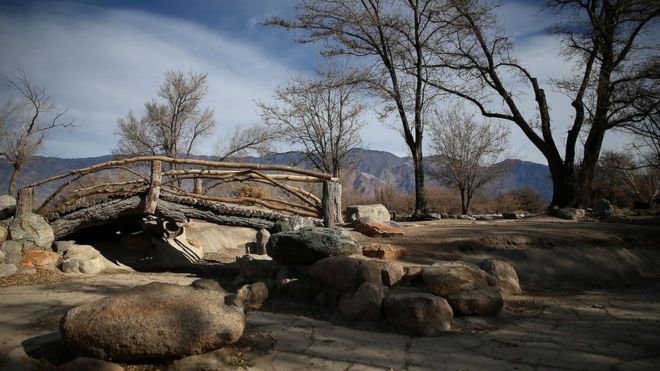
A Japanese garden at a former internment camp at the Manzanar National Historic Site in California
There are about 500 Japanese gardens around the world, such as this one at the World War Two-era Manzanar internment camp for Japanese-Americans in California
Japan is to send gardening experts around the world to restore Japanese-style gardens that have fallen into a state of neglect, officials say.
The gardens have unique features such as stone bridges, ponds, moss-covered paths, stone lanterns and carefully tended miniature trees.
Local gardeners have been overwhelmed by the task of maintaining them.
There are about 500 Japanese gardens around the world of which 40 are in disrepair, the land ministry said.
They require pruning, new plants and trees, and work on traditional stone lanterns that have fallen over.
Officials say the plan is a way of promoting Japanese culture abroad.
The gardens are used by Japanese groups abroad for tea ceremonies, festivals and other events to introduce people to Japanese culture, the Asahi Shimbun newspaper reported.
Embassies have asked the government in Tokyo for help to restore the gardens, AFP news agency reported.
The land ministry says it will send a five-person team to rebuild Japanese gardens in Romania and the US state of California later this year.
The ministry also plans to hold lectures and provide manuals to enable local gardeners to maintain the gardens.
The first overseas Japanese garden was created by the Japanese government in 1873 as part of the Vienna World Expo, and the interest it sparked led to more being built.
Further Japanese gardens were created abroad as part of diplomatic initiatives after World War Two.
The gardens measure about 5,000sq m (1.23 acres) each and are present in more than 100 countries, the Asahi Shimbun said.

Pakistan Sufi shrine: At least 18 killed in Baluchistan

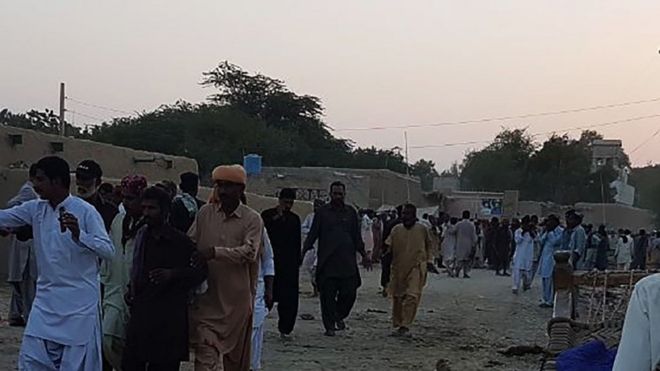
Pakistani devotees gather around the bodies of blast victims after a suicide bombing near a sufi shrine in Jhal Magsi October 5, 2017
Devotees rushed to help the victims following the blast outside the shrine
At least 18 people have been killed and 27 injured in a suicide attack on a Sufi Muslim shrine in Pakistan's south-western province of Baluchistan.
Crowds of devotees had gathered for a three-day religious ceremony when the blast happened.
The shrine is in Jhal Magsi, near the provincial capital Quetta.
The bomber reportedly detonated his explosives after being stopped at the gate of the shrine by a policeman. The officer was killed.
"The suicide bomber struck outside the shrine at a time when it was packed with people attending anniversary celebrations of Syed Cheesal Shah," said local official Asad Kakar, referring to a Sufi saint.
The police officer's actions in stopping the bomber entering the shrine reduced the number of casualties, Baluchistan home minister Sarfraz Bugti told Reuters.
Security forces have sealed off the building, Pakistani media reported.
It is unclear who carried out the attack, but Sufi shrines have been increasingly targeted by Islamist extremists in recent years.
They view Sufism as heretical.
  • Pakistan's Sufis under attack from Islamic hard-liners
  • What is Sufism?
  • Will Pakistan ever stamp out extremism?
In February at least 80 people were killed in an attack on a shrine in Sehwan in southern Sindh province. So-called Islamic State said it was behind that attack.
Sufism is a mystical branch of Islam which spread throughout the Indian subcontinent in the 13th Century.
Sufis believe in saints who can intercede for them directly with God. Several million Muslims in Pakistan are believed to follow Sufism's tenets.

The Indian farmers falling prey to pesticide

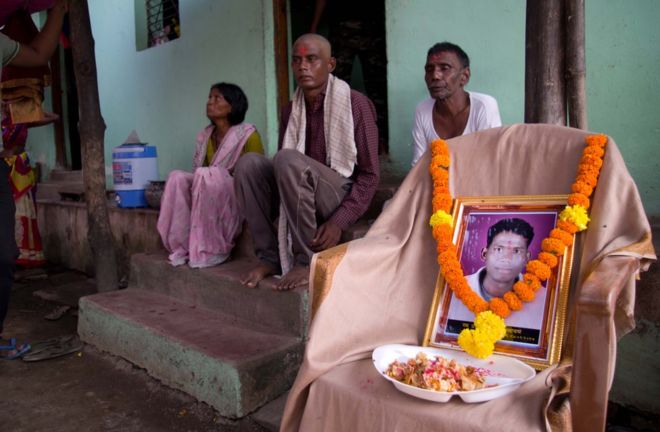
Pravin Soyam's family sit next to a photograph of him
Pravin Soyam, 23, died from inhaling a deadly cocktail of pesticide
The government in the western state of Maharashtra has ordered a probe after suspected pesticide poisoning killed at least 50 farmers. Journalist Jaideep Hardikar reports from Yavatmal district, one of the worst affected areas.
Pravin Soyam, 23, was in perfect health when he suddenly developed a chest pain, followed by vomiting and nausea. Then, he became completely disoriented. He died a day later, on 27 September, at a government hospital.
Doctors who attended to him suspected that Mr Soyam was yet another victim of pesticide poisoning in Maharashtra. They believe he fell sick after inhaling a deadly cocktail of pesticides that he had sprayed on his family's cotton field two days earlier.
At least 50 farmers have died from suspected pesticide poisoning in Maharashtra since July, according to officials and media reports. As the death toll continues to rise, the BJP-led state government has ordered an inquiry.
Most of the deaths - 19 - were reported from Yavatmal district, a major cotton-growing area that has often been in the news for farmers' suicides.
More than 800 farmers in the district were also admitted to hospitals during that time, officials said.
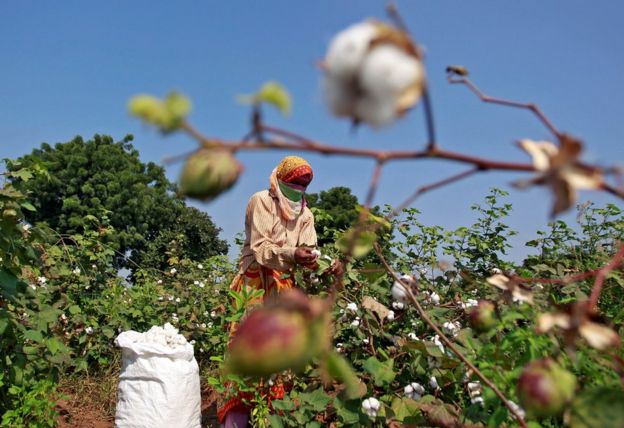
Cotton farm in rural India
Most of the deaths occurred in a major cotton-growing region
Farmers in Yavatmal, who mainly grow cotton, soybean and lentils, told the BBC that they use a highly potent mix of pesticides, both in powder and liquid form.
They also cultivate a genetically modified variety of cotton, which is supposed to be resistant to bollworms, a pest that attacks cotton crops.
But many farmers have said that bollworms still attacked their crops this year, which led them to increase their use of pesticides.
  • Why a problem of plenty is hurting India's farmers
  • How drought is changing rural India
Nikesh Kathane, 21, said he collapsed after spraying pesticide on his crops for seven days in a row.
"I had a very heavy head and I could not see anything," he said while recuperating in the Intensive Care Unit (ICU) of the local hospital.
Mr Kathane, who is out of danger now, said he would never use pesticides again.
In fact, many farmers who spoke to the BBC said they had stopped spraying pesticides for fear of falling sick.
"This is a very unusual phenomenon," Dr Ashok Rathod, dean of the local government hospital told the BBC, adding that the hospital usually treated farmers who deliberately consumed pesticide.
Doctors have said treating accidental poisoning was harder because they can't wash the stomach to remove traces of poison that have been ingested. Inhaling pesticides also affects the respiratory system.Doctors in the area have said they first noticed cases of suspected pesticide poisoning in the last week of July. They admitted 41 patients displaying similar symptoms - vomiting, dizziness, respiratory problems, visual impairment and disorientation.
The figure rose to 111 in August, and more than doubled to 300 in September.
At least 10 of the farmers who are currently being treated at the hospital are on life support, while 25 others have suffered visual impairment, hospital authorities said.
In September, district officials asked agriculture scientists to do a field study to investigate the spate of deaths and illnesses.
The resulting report blamed farmers for not taking precautions while spraying the crop. It said they had not used a prescribed protection kit, eye-glasses or gloves.
Mr Soyam's father, Bhaurao admitted that his son did not follow the safety measures before using the pesticide.
But he said that his son had sprayed pesticides without protective gear in the past as well. So what happened this time?
Had the farmers used a spurious pesticide? Were they using a new formulation they weren't aware of? Had there been any advisories?
Back in Mr Soyam's home, his brother, Namdev, pulled out packets of pesticides that they had sprayed.
"It could have easily been me," he said, staring at a framed photograph of his brother.

Tuesday, September 26, 2017

Palestinian gunman kills three Israelis in West Bank

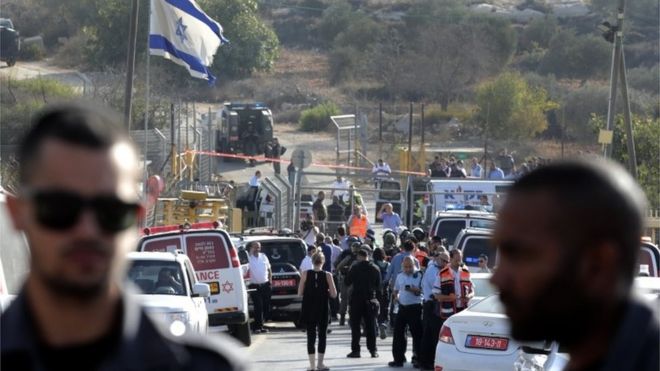
The attack happened as Palestinian workers waited to enter the settlementScene of attack at Har Adar (26/09/17)
Three Israelis have been shot dead by a Palestinian at the entrance to the Jewish settlement of Har Adar in the occupied West Bank, Israeli police say.
The gunman, a 37-year-old from a nearby village, was also shot and died later.
Israeli Prime Minister Benjamin Netanyahu blamed the attack on Palestinian incitement.
It came as Donald Trump's Middle East envoy Jason Greenblatt arrived in Jerusalem to try to revive Israel-Palestinian peace talks.
The White House has tried to lay the groundwork for a resumption of negotiations since Donald Trump took office in January, but there has been no sign of progress.
Peace talks between the two sides broke down amid acrimony in April 2014.
Police say the gunman, identified in Israeli media as Nimer Jamal, struck after he raised suspicions of security personnel at a rear gate at Har Adar.
He shot his victims - two security guards and a border policeman - at close-range and seriously wounded another person, before being shot by security forces.
The gunman was a father-of-four who had an Israeli permit to work in Jewish settlements along the boundary of the West Bank, Israel's internal security agency said.
Image copyrightEPA
Image captionThe gunman opened fire at guards as he approached a checkpoint
He came from the village of Beit Surik, about a mile east of Har Adar.
The area is about 18km (11 miles) north-west of Jerusalem.
No group has taken responsibility for the attack, although Gaza-based Palestinian militant organisations Hamas and Islamic Jihad welcomed it.
The head of the Information Office of Fatah, the political faction of Palestinian President Mahmoud Abbas, said Israel bore responsibility for the attack, because of its "continuous aggression" against the Palestinians.
Israeli Prime Minister Netanyahu said the attacker's home would be demolished and relatives' work permits revoked. He called on Mr Abbas to condemn the attack unequivocally.

Wave of attacks

About 36,000 Palestinians have permits to work in Jewish settlements, where security to guard against attacks is tight.
The issue of settlements is one of the most contentious between Israel and the Palestinians, who see them as an obstacle to peace.
More than 600,000 Jews live in about 140 settlements built since Israel's 1967 occupation of the West Bank and East Jerusalem. The settlements are considered illegal under international law, though Israel disputes this.
Tuesday's attack is the latest in a wave of stabbings, shootings and car-rammings of Israelis predominantly by Palestinians or Israeli Arabs since late 2015.
Since then, some 50 Israelis and five foreign nationals have been killed in such attacks in Israel and the Occupied Territories.
Around 300 Palestinians - most of them assailants, Israel says - have also been killed in that period, according to AFP news agency. Others have been killed in clashes with Israeli troops.
Israel says Palestinian incitement has fuelled the attacks. The Palestinian leadership has blamed frustration rooted in decades of Israeli occupation.

Friday, September 22, 2017

Pig born with TRUNK coming out of its forehead terrifies locals in China

A PIG born with one eye and a trunk coming out of its forehead baffled  locals in China.
The deformed piglet was filmed by fascinated onlookers who held the pig when it was just minutes old in Daqing, Heilongjiang Province.
 The piglet was born with one eye and a trunk coming out of its forehead
The piglet was born with one eye and a trunk coming out of its forehead
 One intrigued woman held and prodded the pig shortly after it was born
One intrigued woman held and prodded the pig shortly after it was born
It had two ears flattened to its head, a large eyeball in the centre and an extra trunk-like limb which had grown above it.
It looped over the cover the eye from the front.
The woman seen in the video smiles as she shows off the deformed animal to crowds.
Footage of the pig, filmed on September 10, has been shared widely on Chinese social media.
The pig sadly died just hours after it was born. It is not known how the pig's deformities were formed.

Japan braces as North Korea threatens hydrogen bomb test in Pacific

  • Kim Jong-un warns ‘deranged’ Trump he will ‘pay dearly’ for North Korea threats
  • Trump says Kim ‘who is obviously a madman’ will be ‘tested like never before’
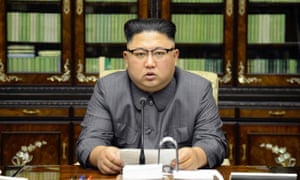
North Korea’s leader Kim Jong Un reads out his statement on state TV.

Japan must brace itself for the possible launch of a nuclear-armed North Korean missile over its territory if the regime carries out a threat to test a hydrogen bomb in the Pacific Ocean, Japan’s defence minister has said.
The warning followed an extraordinary exchange of insults between Donald Trump and Kim Jong-un in response to the US president’s threat at the UN general assembly to “totally destroy” North Korea if Washington was forced to defend itself or its allies.
Kim said that he was considering retaliating at the “highest level”, calling Trump a “mentally deranged US dotard” who would “pay dearly” for threatening to destroy his regime. The North Korean foreign minister, Ri Yong-ho, suggested Pyongyang could test a powerful nuclear weapon in the Pacific.
“It could be the most powerful detonation of an H-bomb in the Pacific,” Ri, who is due to address the UN general assembly at the weekend, told reporters in New York. “We have no idea about what actions could be taken as it will be ordered by leader Kim Jong-un.”
Trump tweeted in response on Friday: “Kim Jong Un of North Korea, who is obviously a madman who doesn’t mind starving or killing his people, will be tested like never before!”
Itsunori Onodera, the Japanese defence minister, warned such a test could involve a nuclear device mounted on a medium-range or intercontinental ballistic missile being flown over Japan. “We cannot deny the possibility it may fly over our country,” he said.
Earlier this month, North Korea detonated a powerful hydrogen bomb at its Punggye-ri nuclear test site in the north-east of the country. The explosion caused a 6.3 magnitude earthquake that was felt over the Chinese border in Yanji.
Testing a nuclear device beyond its own borders would mark a major escalation in tensions over the regime’s ballistic missile and nuclear weapons programmes.
Analysts said a nuclear test involving a missile could be “truly terrifying” if something goes wrong.
An atmospheric nuclear test could pose a risk to aircraft and shipping, even if the North declares a keep-out zone, according to Vipin Narang, a nuclear strategy expert at Massachusetts Institute of Technology.
“And if the test doesn’t go according to plan, you could have population at risk, too,” Narang added. “We are talking about putting a live nuclear warhead on a missile that has been tested only a handful of times. It is truly terrifying if something goes wrong.”
Speculation is growing that North Korea will add to its robust verbal response to Trump’s UN speech on Tuesday with a military provocation, possibly a test of a Hwasong-14 missile, which is theoretically capable of reaching Hawaii and Alaska.
Chung Sung-yoon, an analyst at the Korea Institute for National Unification, said there was a “very high possibility” that Kim would follow through with a provocation of some sort.
While the North has claimed it is able to mount a miniaturised nuclear weapon on a missile, the regime has yet to offer definitive proof.
The US and Japan have warned they will shoot down any missile they consider a threat to Japanese territory.
Monitoring groups estimate that the nuclear test conducted in North Korea this month - its sixth and largest - had a yield of 250 kilotons, which is 16 times the size of the US bomb that destroyed Hiroshima in 1945.
In a statement carried by the official KCNA news agency, Kim called Trump “mentally deranged” and warned him that he would “pay dearly” for issuing threats to the regime during his maiden UN general assembly speech on Tuesday.
Describing the president as “a rogue and a gangster fond of playing with fire”, Kim drew a critical comparison between Trump and his predecessors in the White House, calling him unfit to hold the position of commander in chief.
“Far from making remarks of any persuasive power that can be viewed to be helpful to defuse tension, he made unprecedented rude nonsense one has never heard from any of his predecessors.”
In a combative speech, Trump warned he would “totally destroy” North Korea if it attacked the US or its allies, and called on other countries to cut the regime off from its sources of funds.
“The mentally deranged behaviour of the US president openly expressing on the UN arena the unethical will to ‘totally destroy’ a sovereign state … makes even those with normal thinking faculty think about discretion and composure,” Kim said.
The North Korea leader is thought to be the first of three generations of the Kim dynasty to publicly read out a statement aimed at the international community in his own name.
South Korea’s unification ministry said neither Kim’s father, Kim Jong-il, nor his grandfather - and North Korean founder - Kim Il-sung, had issued a similar statement.
Kim said Trump’s remarks had convinced him “that the path I chose is correct and that it is the one I have to follow to the last”.
He added that he was “thinking hard” about his response, but vowed that Trump would “pay dearly for his speech calling for totally destroying” North Korea.
“Action is the best option in treating the dotard, who, hard of hearing, is uttering only what he wants to say,” he said.
“Now that Trump has denied the existence of and insulted me and my country in front of the eyes of the world and made the most ferocious declaration of a war in history that he would destroy [North Korea], we will consider with seriousness exercising of a corresponding, highest level of hard-line countermeasure in history.”
His lengthy criticism of Trump ended: “I will surely and definitely tame the mentally deranged US dotard with fire.”
The statement came just hours after Trump issued a new executive order that expands US sanctions on North Korea’s shipping, banking, ports and manufacturing. Trump also claimed China’s banking system had shut down business with the country.
Reuters reported earlier in the day that China’s central bank had ordered financial institutions to implement UN sanctions rigorously after frequent complaints from Washington that Beijing was leaving open too many loopholes.
Trump thanked China’s president Xi Jinping and said the move was “very bold” and “somewhat unexpected”.
There was no immediate confirmation from the Chinese government that it had imposed a financial embargo on North Korea. If confirmed, it would represent a significant tightening of the economic noose around the Pyongyang regime, by a country which accounts for 90% of its trade.
But it is unclear whether any amount of financial or economic pain would induce Kim Jong-un to relinquish North Korea’s nuclear weapons and missiles, which he believes are essential for the regime’s survival.
Advertisement
Trump announced the new executive order during a working lunch with his South Korean counterpart, Moon Jae-in, and Shinzō Abe, the Japanese prime minister.
“Our new executive order will cut off sources of revenue that fund North Korea’s efforts to develop the deadliest weapons known to humankind,” Trump said. “The order enhances the treasury department’s authorities to target any individual or entity that conducts significant trade in goods, services, or technology with North Korea.”
Under the new measures, no ship or aircraft can visit the US within 180 days of going to North Korea. The same restriction would apply to any vessel involvement in ship-to-ship transfers with North Korean vessels. The order gives the US Treasury the power to sanction anybody involved in a wide variety of North Korean industries, ports, trade, and banking.
“Foreign financial institutions must choose between doing business with the United States or facilitating trade with North Korea or its designated supporters,” a White House statement said.
“To prevent sanctions evasion, the order also includes measures designed to disrupt critical North Korean shipping and trade networks,” he said. “For much too long, North Korea has been allowed to abuse the international financial system to facilitate funding for its nuclear weapons and missile programs.”
On the same day, the EU announced new sanctions of its own, including a ban on investment in North Korea and on EU exports of oil. The impact will be minimal, as trade and investment relations between North Korea and EU are tiny.


Wednesday, August 9, 2017

North Korea: Shocking Warning To America WASHINGTON, D.C. – The Pentagon is scrambling to protect America’s power grid amid fears of attack by North Korea. Former CIA Director James Woolsey:


"According to the Congressional EMP Commission, a single warhead delivered by North Korean satellite could blackout the national electric grid and other life-sustaining critical infrastructures for over a year – killing nine of 10 Americans by starvation and societal collapse.”
President Trump is facing this threat head-on and he is not backing down. He told Reuters, "There is a chance that we could end up having a major, major conflict with North Korea. Absolutely."
North Korea realizes they can’t beat us with brute military force on the conventional battlefield. We are way too strong for that.
However we do have a weakness that North Korea or other foreign terrorists can use against us…
Our crumbling electric grid.
Former CIA official Dr. Peter Pry warns, “There is an imminent threat… to the national electric grid and not just to a single U.S. city.”
When our electric grid fails, it will be like watching America have a heart attack right before your eyes. Because when the heart stops pumping… everything shuts down and the patient flat lines.
Our enemies could cripple our great country in a matter of minutes, without having to fire a single bullet. They could just sit back and watch as we self-destruct through looting, rioting and the targeting of police officers.
It’s a frightening idea, but worst of all…
It may already be happening.
On April 21, three major U.S. cities – New York, Los Angeles and San Francisco – experienced virtually simultaneous power outages. Businesses emptied. Schools closed. Subway commuters were stuck underground in the dark.
Rumors immediately started flying that a cyber-attack had caused all three blackouts.
The "official" word in San Francisco was that the outage was caused by a fire in a substation. In Los Angeles, high winds were blamed. In New York, an equipment failure was the announced culprit.
Perhaps those were the real causes. Or maybe these simultaneous blackouts were dry runs for future attacks.
We may never know the truth.
But former CIA Director Dr. Peter Pry says that attacks on just 9 of the nation’s 55,000 electrical substations could result in nationwide blackouts for up to 18 months.
Our government is woefully unprepared.
It seems like the government has been fixated on taking more and more away from people who worked hard to earn it, while doing virtually nothing to secure our nation’s infrastructure.
They’ve ignored dire warnings from experts about the grid’s vulnerability to physical, electromagnetic pulse (EMP) and cyber-attack by North Korea, Russia, China and even ISIS and other terrorist groups.
“Our death toll would be staggering” reports FOXNews. We’re all fine when the power goes out for a few hours and even days. But an extended blackout would be devastating.
Frank Gaffney, founder of the Center for Security Policy predicts, “… should the power go out and stay out for over a year, 9 out of 10 Americans would likely perish.”
Imagine a blackout lasting not days, but weeks or months. Your life would be frozen in time right at the moment the power fails. Lights all over the country would go out, throwing people into total darkness.
Without access to a generator, your fridge, electric range and microwave would be dead. All the food in your fridge and freezer would spoil.
Your well couldn’t pump any fresh water into your house. And even if you don’t have a well, a total grid failure means no fresh water to drink, cook, or clean with.
You wouldn’t be able to operate your radio or TV, or charge your cell phone, so you’d feel isolated and cut off from your friends and family.
Sadly, this is NOT science fiction or some crazy doomsday theory…
And retired CENTCOM General Lloyd Austin says, “It’s not a question of if, it’s a question of when.”
Will you be prepared for this devastating crisis… one that could take months or even years to recover from?
How will you stay safe… warm… and protected?
That’s why many Americans are taking matters into their own hands and are securing their own solar powered generator.
Solar generators are a smart choice because they produce an endless supply of life-saving electricity when you need it most – and without gas, fumes or noise.
That’s enough to power lights for safety and comfort, your computer, TV, or cell phone. Even small appliances like a small freezer or critical medical device that will sustain your family during a power outage.
Imagine how much peace of mind you’ll have right away when you get your own. Because if a crisis hits and your family asks, “When will the power come back on?” you’ll calmly reassure them that they’re safe and they will have plenty of electricity to power the critical items.
You’ll be able to power lights… preserve food… recharge cell phones and computers… or keep critical medical devices going.
Your home will be a little island of light and warmth in a storm – be it natural or man-made.
Listen, nobody can predict the future. None of us know exactly when or how an attack on our electrical grid will hit.
But from everything we see, it could be soon and it could be devastating.

Powerful earthquake kills at least 19 in China, hundreds injured

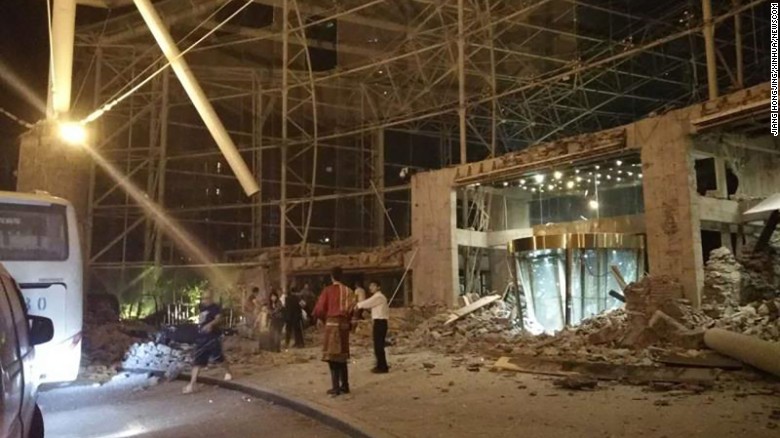
Rubble sits in front of a hotel after an earthquake struck Jiuzhaigou County in China's Sichuan Province.
At least 19 people were killed and 247 more injured late Tuesday after a powerful earthquake struck a popular tourist area in southwest China, according to state media.
Of those hurt, about 40 are in a serious condition, state news agency Xinhua reported.
    The quake struck Jiuzhaigou County in China's southwestern Sichuan Province late on Tuesday night.
    At least five of the people who died were tourists, Xinhua reported, citing the information office of the provincial government. About 2,800 people were evacuated from the severely damaged Intercontinental hotel.Rescuers are still working to clear the rubble, and there are people buried beneath the debris, state broadcaster CCTV said.
    There was some disagreement over the size and power of the earthquake.
    The US Geological Survey reported a magnitude-6.5 quake 35 kilometers (22 miles) west-southwest of Yongle, Xinhua reported it was 7.0-magnitude, citing the China Earthquake Networks Center.
    Residents in Chengdu, the provincial capital -- 300 kilometers (186 miles) away from the epicenter -- told state media they had felt the quake.
    Chinese paramilitary police search for survivors after an earthquake in Jiuzhaigou in southwest China's Sichuan province early on August 9.
    The China Earthquake Administration has launched a Level I emergency response, the highest of its four levels, according to state media.
    Almost 400 fire trucks and more than 1,100 firefighters were dispatched to the scene, CCTV said. They are bringing with them 55 life detectors, 30 rescue dogs and 24 generators.
    Local authorities announced the closure of the Jiuzhaigou tourist area, which includes a national park known for its waterfalls and topographical formations, beginning Wednesday.
    Yu Qian, a local taxation bureau official, told Xinhua that the earthquake cut off power and disrupted phone service in her neighborhood.
    Firefighters in China's Gansu province preparing to head to Sichuan on August 8.
    Photos from the scene showed what appeared to be pieces of buildings lying in the street, a stone the height of a small automobile in the street and a heavily damaged hotel entrance, its revolving doors twisted and rubble lying in front of them.
    The temblor wasn't the only quake in China in the past 24 hours.
    On Wednesday morning, a magnitude-6.3 earthquake struck northwestern China's Xinjiang Uyghur Autonomous Region, close to the border to Kazakhstan, the United States Geological Survey said.
    The quake struck at 7:27 a.m. local time. Its epicenter was 107 kilometers (67 miles) south-southeast of Dostq, Kazakhstan, at a depth of 25.9 kilometers (16 miles), the USGS said.
    There were no immediate reports of casualties or damage, due to the sparsely populated nature of the area.