Wednesday, August 9, 2017

'They have nothing to lose. We do': Australia struggles with extremist threat

For most young Australians, the violence and extremism of Syria feels a world away. But for a tiny minority, ISIS exerts a powerful allure, leading a small but significant number to head to the Middle East to take up arms.
And while the de facto capital of the self-described ISIS caliphate is more than 8,000 miles (13,000 kilometers) from Sydney, the murderous group's reach is keenly felt here -- as Australia reels from what police say was a narrowly averted, ISIS-assisted plot to bring down a plane.
For some, the ISIS connection is real and immediate.
"I know two friends, two personal friends of mine who traveled to fight for ISIS," says a 20-year-old university student who asks to remain anonymous, out of safety concerns.
"One was my best friend from primary school, the other guy I saw at the gym -- he was very close to my brother-in-law.He was a groomsman at my sister's wedding."
For a small number of Muslim Australians living here, theirs is a life of alienation, he says. The university student, who is from Melbourne, tells CNN that despite what they have in common, many young Muslims are made to feel like strangers in their own land.
"I do believe it's because of a lack of belonging here in Australia," he says from his university campus. "When anyone travels overseas often there we're known as Australian. Here in Australia we're known as foreigners."Around 220 Australians have traveled to Syria and Iraq, where around half are believed to be currently fighting or engaged with terrorist groups, according to an Australian Security Intelligence Organization (ASIO) spokesperson.
Counter-terrorism experts like Greg Barton, chair of Global Islamic Politics at Deakin University, believe the figures could be even higher. He estimates as many as 260 Australians could have traveled to the region, most of whom have taken up arms with ISIS.
While the Muslim population in Australia is relatively small, a study last year from the National Bureau of Economic Research suggested the country ranks highly in comparison to other English-speaking nations when it comes to the number of ISIS foreign fighters per Muslim population.
Hass Dellal, executive director of the Australian Multicultural Foundation, says communities need to provide a much stronger counter-narrative around the allure of groups like ISIS.His foundation has received funding from the Australian government to run workshops that teach families, police and community workers to look for the warning signs of radicalization.
"The messaging that's coming out is nothing but propaganda, and it's about luring them into a false sense of security," Dellal says, listing some of the messages of inclusion he says ISIS tells disaffected Australians.
"'We'll make you feel better. We'll make you feel important. We'll give you a family. We'll give you a sense of belonging. We'll give you some worth. Come and fight for a cause.'"
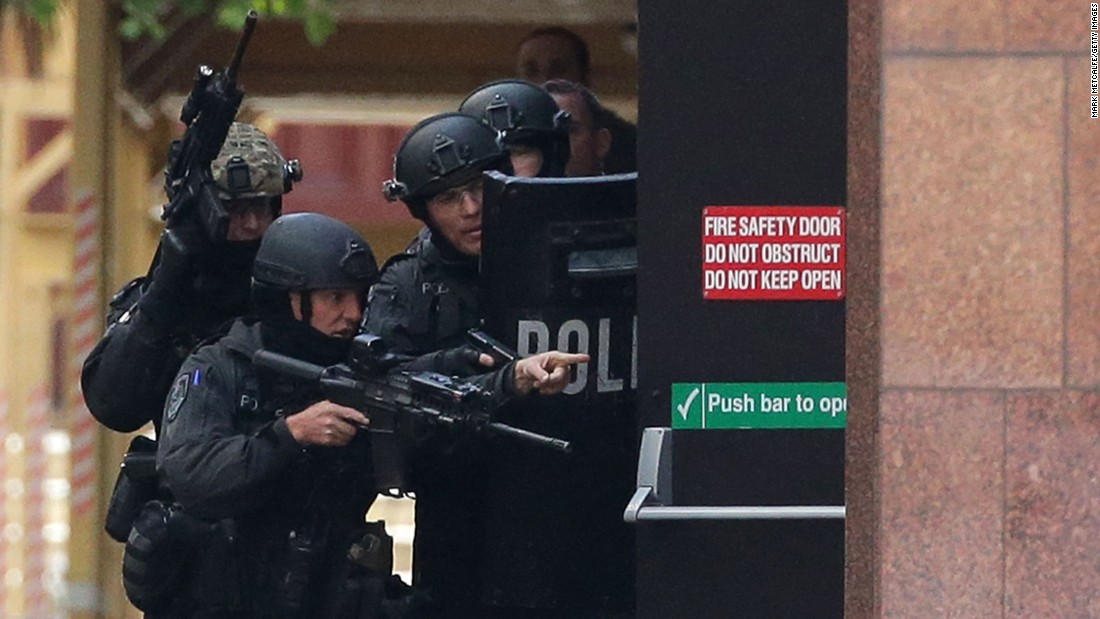
Armed police are seen outside the Lindt Cafe, Martin Place on December 15, 2014 in Sydney, Australia.

Ticking time bombs

While the prospect of radicalized Australians traveling overseas is worrisome, there is a more local, pressing problem.
    There have been five terror attacks in Australia since September 2014, when the national terrorism threat level was raised, and 13 "major (counterterrorism) disruptions" -- foiled plots -- according to an Australian Security Intelligence Organization (ASIO) spokesperson.
    The most high-profile attack to date was the December 2014 siege on a Sydney cafe where a self-styled Muslim cleric took 17 people hostage. Two hostages and the gunman died.
    The latest threat was exposed last week, when two men living in Sydney were charged with terror-related offenses. They have not entered a plea.
    Federal police allege they were involved in a shocking plot, the "most sophisticated" ever conceived on Australian soil, which centered around an attempt to bomb a passenger plane, though the plan was aborted.
    They were also allegedly planning to launch a poison gas attack in a crowded public place.
    If the perpetrators hadn't been thwarted, the attacks would have been "catastrophic," Australian Federal Police Deputy Commissioner Michael Phelan said.
    The men had been in direct contact with a senior ISIS commander who sent bomb components to them in the Sydney suburbs, police allege.
    With ISIS suffering defeats in Iraq and Syria, there's concern it will pull out all stops to demonstrate it remains a potent force.
    Those at home -- with connections abroad -- are the ones experts say need to be watched, says Barton.
    "In some cases we've got ticking time bombs. People who are broken, confused and if approached and groomed by those who want to use them, could once again become dangerous."
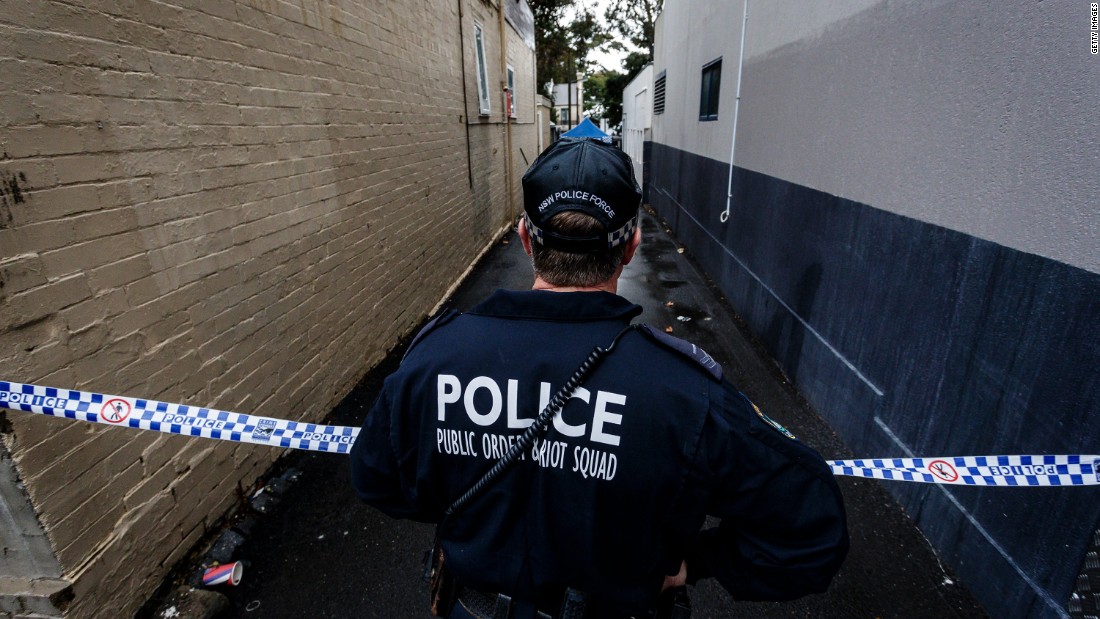
    A Police officer watches over an ongoing operation in Surry Hills on July 31, 2017 in Sydney, Australia.

    Under siege

    There are around 600,000 Muslims in Australia, the vast majority of whom disavow ISIS' brutality.
    One high-profile Muslim community leader told CNN that news that the plot was disrupted was met with relief.
    "Relief because they were caught before the act, and relief for those innocent people," said Jamal Rifi, a Australian Lebanese Muslim GP, who has run his own surgery in Sydney for 27 years.
    Relief too, he noted, "because just imagine the sort of backlash that would happen to the Muslim community if something like this takes place."
    Many Muslim groups, particularly conservative Salafi communities in Sydney and Melbourne, say they feel under siege by the rise of conservative politics in Australia, says Clarke Jones, a criminologist at Australian National University who works in de-radicalization and counter-terrorism.
    "You have people who feel racism, particularly young people who don't have those critical thinking skills. It's a complex issue, so the solutions are very complex too."
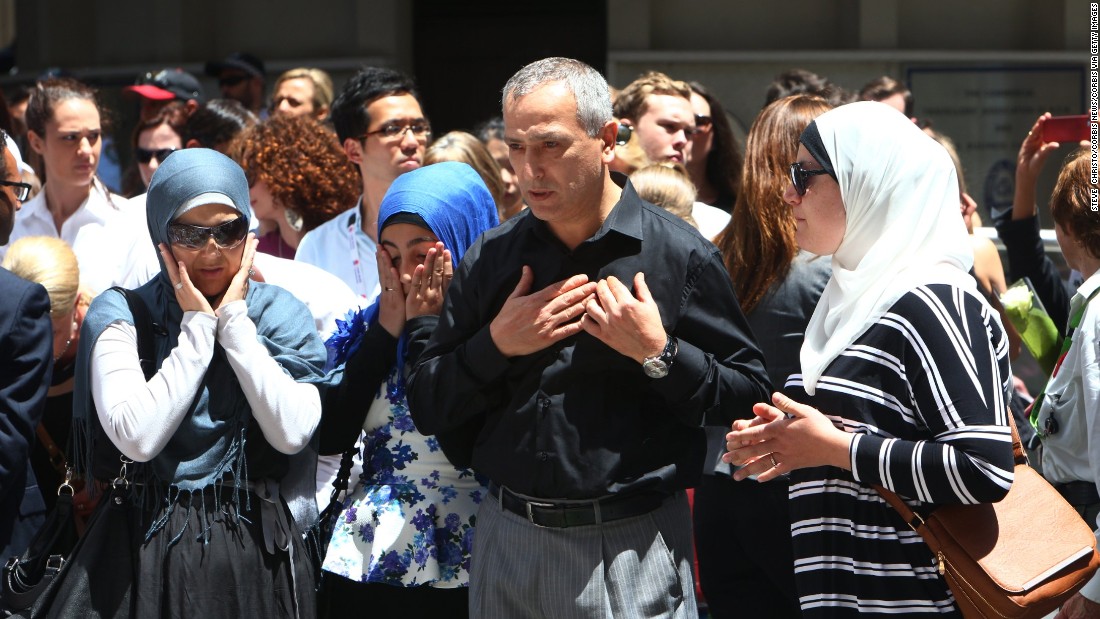
    Muslim community leader Dr Jamal Rifi and family members lay a wreath at the makeshift memorial at Martin Place after the 2014 shootings at the Lindt coffee shop in Sydney's Martin Place. Sydney Australia.
    Outreach

    The university student who saw two of his friends travel to ISIS-held territory says the government isn't doing enough to deter them.
    "It will be a lot more worse than it is now because we are not doing enough to stop it and if (ISIS) have any means to contact people they will do it. They have nothing to lose. We do."
    The government has poured tens of millions of dollars into de-radicalization programs across the country that work with communities and families to identify early warning signs.
    And while prevention is hard to measure, organizers are confident they're seeing results, particularly from efforts to work with Muslim communities and their leaders to nip radicalization in the bud.
    "There aren't many mothers who are going to dial a hotline and dob in a son even if they feel something is wrong," says Dellal.
    "But they may do something at the grassroots level, if they're connected to people they can trust and confide in."

    Why 'A Nasty Boy' magazine is causing a stir in Nigeria


    Bold, disruptive and totally unapologetic, a new Nigerian online magazine 'A Nasty Boy,' is set to ruffle a few feathers.
    "Sometimes our visual content will not be safe for the workplace... we won't make it any easier for you with our provocative editorials and swear words; take it in good spirits," read's the magazine's disclaimer.
      The magazine is filled with provocative images, featuring nude models, articles contain swear words and avant-garde ideas.
      In Nigeria, a conservative country, where public expressions of nudity are uncommon, 'A Nasty Boy' is unsurprisingly causing controversy.
      But for editor Richard Akuson, the publication is sending out a clear message: he's not interested in fitting the status quo.

      'There has to be room for people that don't fit in'

      Growing up, Akuson says he was bullied for being different.
      "I was always called a boy-girl," Akuson told CNN.
      "In university, I was called a yansh man which means a guy with a big butt...my classmates thought I was too polite, in their words too polished and that was not the way guys were meant to be."
      It was this idea, that a man or woman is meant to behave in a particular way, that Akuson sought to challenge through 'A Nasty Boy.'
      "There cannot be one singular kind of Nigerian man or woman, there has to be room for other definitions that don't necessarily fit that opinion," he adds.
      Akuson had previously launched three other publications but says none of them felt right, he was pushed to publish 'A Nasty Boy,' after a run in with internet trolls.

      Celebrating 'otherness'

      "I once did a story on EJ Johnson... and how I felt his wardrobe could inspire, but the conversation in the comment section completely moved from the subject matter to me. 'Why are you always interested in stories like this?; and some responses were 'Oh you know Richard is gay'"
      "That was the awakening for me," he said. "And from that morning I knew I would start 'A Nasty Boy.'"
      Akuson says after his experience he knew the time had come for a platform that allowed for self-expression and shape-shifting ideas and explored "otherness in fashion, people and culture."
      "There are people who do not fit the status quo but are however very Nigerian," he explains. "We should hear their stories and also celebrate them."

      'Fear of association'

      While the public is slowly warming up to his publication, there is still fear and hesitation to be publicly associated with the magazine Akuson claims.
      A large chunk of the magazine's readership resides in Nigeria, Akuson notes that the number isn't reflected in their social engagement. He feels it's because people are still weary to be publicly associated with subject matter that could be considered taboo.
      In an photo editorial called 'Boys', Akuson tried to challenged the perceived notion of strangeness surrounding men being naked around one another. After it was published, he observed something unusual.
      "I could see from my analytics that the photo had been seen many times but the engagement was not as much. Then I got messages and calls from people who thought it was impressive work and I asked, 'why didn't you leave a comment?'"
      Funding also poses a huge problem for his ambitious publication with potential investors questioning its importance.
      "We have met people who just say outright that this is not a necessary publication, it could be something else, and it doesn't have to be this. They don't understand why it's necessary."

      Bold and unapologetic

      But Akuson does, and is driven by the effect the magazine has on people who connect to the message and need to celebrate difference.
      Akuson shares the story of a photographer who collaborated with him on an editorial, whose father broke his camera because he found photos of naked men on it. The incident prompted the photographer to give up on photography, but seeing his work in 'A Nasty Boy' feature on a British website lit his fire again.
      Financial setbacks and going against the grain of Nigeria's conservative principle aside, Akuson's focus is in one direction and he is doing it boldly, and unapologetically.


      Iraq sentences 27 men to death for roles in 2014 Speicher massacre


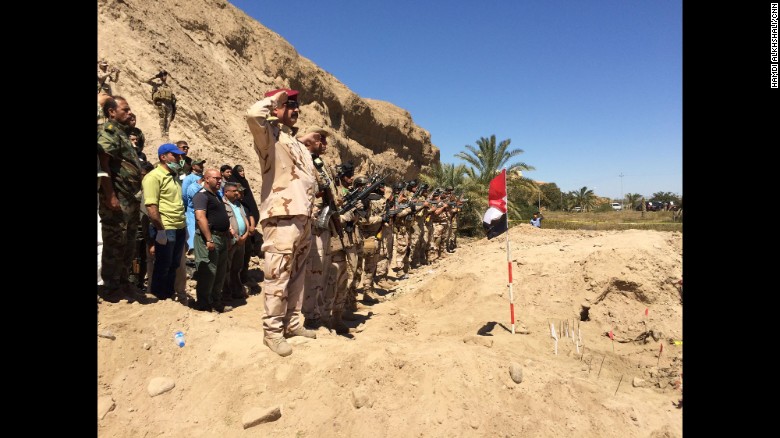
      Iraqi soldiers salute a mass grave that is thought to hold as many as 1,700 bodies that were killed in the Camp Speicher massacre.

      Iraq sentenced 27 prisoners to death for their part in a 2014 massacre that killed as many as 1,700 men in ISIS-controlled territory, according to a statement released by Iraq Central Criminal Court.
      "The Central Criminal Court issued a verdict to execute 27 defendants convicted of participating in the Speicher massacre," Judge Abdul Sattar al-Beeraqdar, a spokesman for Iraq's Higher Judicial Council, said in a statement released Tuesday.
      However, Beeraqdar said the decision is "preliminary and can be appealed."
        This is the second mass conviction relating to the so-called Speicher massacre committed by ISIS members in 2014.
        ISIS released videos after the massacre that showed a line of Iraqi military recruits being marched at gunpoint. Later, ISIS posted images showing mass murders.
        In 2016, Iraq hanged 36 people for taking part in the massacre. They were executed at Al-Hoot prison in Nasiriyah province, south of Baghdad.
        The killings have come to be known as the Speicher massacre because they took place at Camp Speicher, a former US base near Tikrit, after ISIS forces took control of the area.
        The massacre was described by Human Rights Watch as the "largest reported incident" where "ISIS captured more than 1,000 soldiers fleeing Camp Speicher ... then summarily executed at least 800 of them."
        mass grave was uncovered in Tikrit in 2015, where as many as 1,700 bodies were recovered. Officials believe these bodies were of the men involved in the Speicher massacre.

        Powerful earthquake kills at least 19 in China, hundreds injured

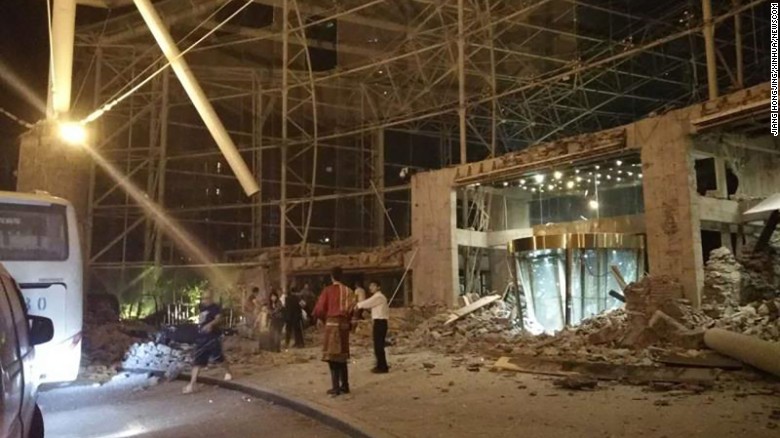
        Rubble sits in front of a hotel after an earthquake struck Jiuzhaigou County in China's Sichuan Province.
        At least 19 people were killed and 247 more injured late Tuesday after a powerful earthquake struck a popular tourist area in southwest China, according to state media.
        Of those hurt, about 40 are in a serious condition, state news agency Xinhua reported.
          The quake struck Jiuzhaigou County in China's southwestern Sichuan Province late on Tuesday night.
          At least five of the people who died were tourists, Xinhua reported, citing the information office of the provincial government. About 2,800 people were evacuated from the severely damaged Intercontinental hotel.Rescuers are still working to clear the rubble, and there are people buried beneath the debris, state broadcaster CCTV said.
          There was some disagreement over the size and power of the earthquake.
          The US Geological Survey reported a magnitude-6.5 quake 35 kilometers (22 miles) west-southwest of Yongle, Xinhua reported it was 7.0-magnitude, citing the China Earthquake Networks Center.
          Residents in Chengdu, the provincial capital -- 300 kilometers (186 miles) away from the epicenter -- told state media they had felt the quake.
          Chinese paramilitary police search for survivors after an earthquake in Jiuzhaigou in southwest China's Sichuan province early on August 9.
          The China Earthquake Administration has launched a Level I emergency response, the highest of its four levels, according to state media.
          Almost 400 fire trucks and more than 1,100 firefighters were dispatched to the scene, CCTV said. They are bringing with them 55 life detectors, 30 rescue dogs and 24 generators.
          Local authorities announced the closure of the Jiuzhaigou tourist area, which includes a national park known for its waterfalls and topographical formations, beginning Wednesday.
          Yu Qian, a local taxation bureau official, told Xinhua that the earthquake cut off power and disrupted phone service in her neighborhood.
          Firefighters in China's Gansu province preparing to head to Sichuan on August 8.
          Photos from the scene showed what appeared to be pieces of buildings lying in the street, a stone the height of a small automobile in the street and a heavily damaged hotel entrance, its revolving doors twisted and rubble lying in front of them.
          The temblor wasn't the only quake in China in the past 24 hours.
          On Wednesday morning, a magnitude-6.3 earthquake struck northwestern China's Xinjiang Uyghur Autonomous Region, close to the border to Kazakhstan, the United States Geological Survey said.
          The quake struck at 7:27 a.m. local time. Its epicenter was 107 kilometers (67 miles) south-southeast of Dostq, Kazakhstan, at a depth of 25.9 kilometers (16 miles), the USGS said.
          There were no immediate reports of casualties or damage, due to the sparsely populated nature of the area.

          Tuesday, August 8, 2017

          Neptune storm 'extremely surprising'


          A storm 6,000 miles wide has been found raging on Neptune in what scientists say is an 'extremely surprising' discovery.
          The massive system is marked by bright clouds near the equator where they have never been seen before.
          Experts say such clouds are normally closer to the poles.
          They believe a huge high-pressure, dark vortex anchored deep in the atmosphere may have caused the storm, which is almost as big as Earth.
          Gases rising up in the vortex are thought to be cooling and condensing out to form clouds.
          Unlike the watery clouds on Earth, those on Neptune consist of methane.
          Professor Imke de Pater, from the University of California at Berkeley in the US, said: 'Historically, very bright clouds have occasionally been seen on Neptune.
          'But usually at latitudes closer to the poles, around 15 to 60 degrees north or south. Never before has a cloud been seen at or so close to the equator, nor has one ever been this bright.'
          But it may not be linked to a vortex and instead could be a huge convective cloud similar to those seen on other planets, including one detected on Saturn in 2010.
          However, a convective cloud would be expected to 'smear out' significantly over a period of about a week.
          UC Berkeley graduate student Ned Molter made the discovery during a dawn test run of the WM Keck Observatory telescope on Maunakea, Hawaii.
          Mr Molter, who observed it getting much brighter between 26 June and 2 July, said: 'Seeing a storm this bright at such a low latitude is extremely surprising.'
          Neptune, the fourth biggest planet in the solar system, is the windiest with wind speeds at the equator reaching up to 1,000mph.
          In comparison, a Category 5 hurricane on Earth has wind speeds of 156mph and the most powerful tornadoes spin at around 300mph.